 English
  Nepali
 High-level and local stakeholders come together to plan at TECSES kick-off events

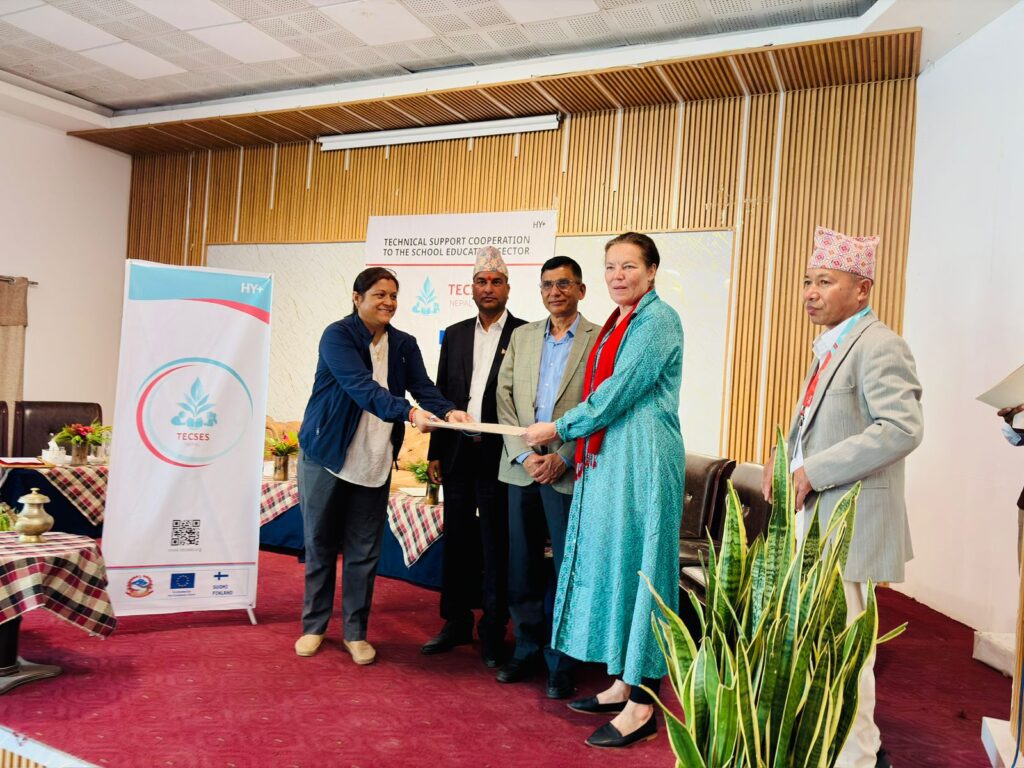
TECSES held kick-off workshops in Madhesh and Sudurpaschim Provinces to engage provincial and local stakeholders in the project’s activities, marking an important step in strengthening Nepal’s education sector.
In Sudurpaschim, the project was launched by the Honorable Minister of Social Development, Megh Raj Khadka, and Secretary Dr. Hem Raj Regmi.
In Madhesh, the launch was led by the Minister of Education and Culture, Rani Kumari Tiwari, together with Joint Secretary Shiva Sapkota from the Ministry of Education, Science and Technology.
In both provinces, TECSES works closely with key partners such as provincial ministries, education directorates, training centres, and local governments. In Sudurpaschim, the project collaborates with nine local governments and Far Western University to support the development of a bachelor-level teacher education programme. In Madhesh, TECSES partners with eight local governments and Madhesh University to launch a diploma-level programme.
Through these partnerships, TECSES aims to strengthen teacher education and support long-term, coordinated development of the education system with strong local ownership.
In Karnali, TECSES has already made good progress. The project has supported School Improvement Plans at the local level and worked closely with school communities. Pedagogical Resource Persons (PRPs) have been recruited and are supporting teachers’ professional development based on their needs. These good practices will now be extended to Madhesh and Sudurpaschim.
Read more about our kick-off events on other media:
https://pathashalakhabar.com/news.php?nid=778
https://radioattariya.com/archives/26435
https://sudurkhabar.com/archives/370906
https://dhangadhipost.com/news/7505
https://raikwarkhabar.com/article/91078.html
https://www.rubuskhabar.com/uncategorized/16860/
******
TECSES is a teacher education project in Nepal, supported by Finland and the European Union. We work to improve schools through teacher training and inclusion at the federal, provincial, and local levels of government, and Nepali universities.